What’s Shaping
Agriculture Right Now
Four consequential developments and what they reveal about the markets, finance and infrastructure shaping African agriculture.
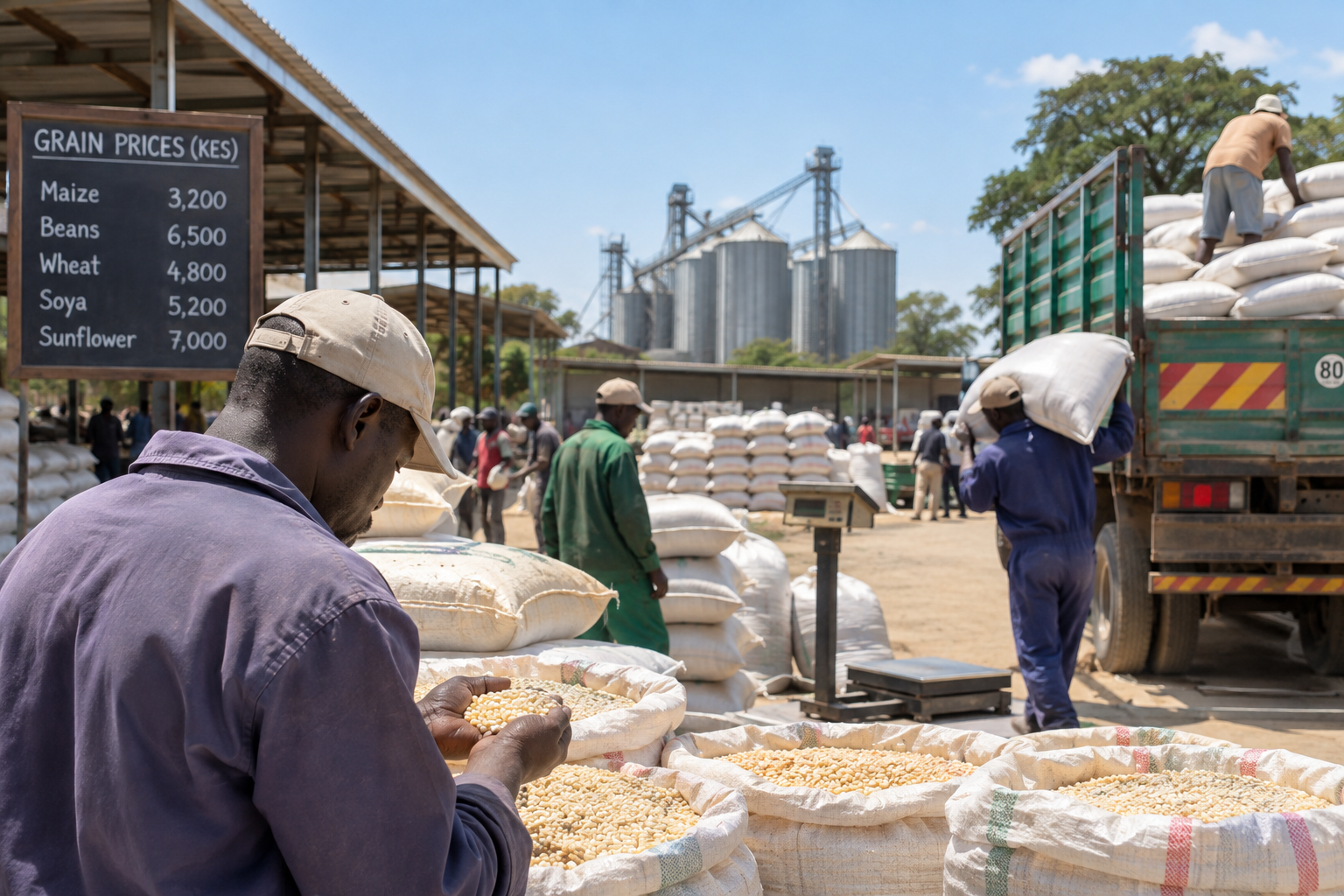
Kenya’s maize shortage is becoming a regional market story
Drought and crop losses in Kenya’s major maize-growing areas created a substantial supply deficit, with government planning imports of up to 25 million 90kg bags. Increased Kenyan demand affected regional grain markets and contributed to higher maize, flour and animal-feed prices in Uganda.
Kenya also considered yellow-maize imports specifically to reduce competition between animal-feed manufacturers and millers producing food for human consumption.
A production shock in Kenya does not remain a Kenyan farm problem. It moves through regional grain trade, feed markets, food prices and ultimately affects multiple agricultural value chains.
Financing Kenya’s shift to quality-based milk pricing
Kenya Dairy Board, the State Department for Livestock Development and UNIDO convened financial institutions, SACCOs, dairy cooperatives, processors and technology providers to explore financing Kenya’s transition to Quality-Based Pricing.
Investments under discussion included milk analyzers, testing and cooling equipment, digital systems, quality-control infrastructure and working capital.
Paying farmers based on milk quality rather than simply volume requires more than a new pricing model or policy. It requires physical infrastructure, appropriate financing and credible data systems across the dairy chain.
East Africa tests risk-sharing to expand climate finance
IFAD and Equity Group launched ARCAFIM, a US$200 million blended-finance mechanism targeting approximately 260,000 smallholder producers and 500 rural enterprises across Kenya, Uganda, Tanzania and Rwanda.
Rather than relying on grants alone, the mechanism combines concessional capital, risk-sharing and Equity Group’s balance sheet to expand commercial lending for climate adaptation.
The financing gap in agriculture is not simply about the availability of capital; it is also about who carries risk. ARCAFIM tests whether sharing risk differently can make lending to underserved agricultural segments commercially viable at scale.
Kenya prepares agriculture for a wetter season
Kenya began distributing 99,000 metric tonnes of subsidized fertilizer at KSh2,000 per 50kg bag, urging accelerated distribution and farmer sensitization ahead of expected El Niño rains.
ICPAC’s outlook indicated an increased likelihood of wetter-than-normal October-to-December conditions across parts of the Greater Horn of Africa, including a high probability of enhanced rainfall in parts of northeastern Kenya, southern Ethiopia and central-to-southern Somalia.
More rainfall can support crop and fodder production, but excessive rainfall can also increase flooding, waterlogging, crop disease, livestock-health and logistics risks. The question is not simply whether it rains, but whether production systems are prepared to convert rainfall into productivity.
The Week
in One View
Beyond the individual developments, three wider questions stood out to us this week.
Agricultural finance is also a risk-allocation question.
More capital does not automatically translate into more agricultural lending. Agriculture carries risks (weather, production cycles, price volatility and fragmented markets), that lenders must be able to price, absorb or share.
That shifts the financing question. It is not only about how much capital is allocated to agriculture, but about the architecture surrounding that capital: who absorbs first loss, where guarantees sit, what risks can be insured, what evidence lenders use to assess borrowers, and how much uncertainty remains on their balance sheets.
Mechanisms such as ARCAFIM therefore matter beyond the headline amount committed. Their significance will ultimately depend on whether risk-sharing changes lender behaviour, allowing financial institutions to reach agricultural borrowers, enterprises and investments they would otherwise consider too costly or uncertain to finance.
The wider question for agricultural finance is increasingly not simply where will the money come from?, but what has to change for existing capital to become deployable?
Quality-based pricing puts dairy data infrastructure in the spotlight.
Kenya’s Quality-Based Pricing transition is often framed as a question of testing equipment and farmer incentives. But once quality determines farmer income, the underlying data chain becomes part of the market itself.
A credible QBP system must connect milk delivery to sampling, test results, quality classification, price calculation and payment. Each step raises questions of provenance: which farmer supplied the milk, when and where was the sample taken, who tested it, using what method or device, whether the result can be altered, and whether farmers, cooperatives and processors can verify the same record.
These are not merely technology questions. They become questions of market trust. A disputed quality result can become a disputed payment; weak provenance can undermine confidence in the pricing model itself.
As agricultural markets increasingly use data to determine price, compliance and market access, trusted data infrastructure begins to function much like physical market infrastructure: something the transaction depends on.
When food markets and feed markets collide.
Kenya’s maize shortage exposes a tension that staple-food policy can easily overlook: the same grain market can serve both human food consumption and livestock production.
When maize supply tightens, millers producing food and manufacturers producing animal feed compete for a smaller pool of grain. The resulting pressure does not stop at the maize price. Higher feed costs move into poultry, dairy and other livestock value chains through higher production costs and tighter producer margins, and can eventually influence the prices consumers pay for milk, eggs and meat.
Kenya’s consideration of yellow-maize imports for feed therefore points to a wider market-design question: whether differentiated grain supply can reduce competition between food and feed uses during periods of scarcity.
The broader policy challenge is to protect staple-food security without unintentionally weakening livestock competitiveness or constraining the supply of other foods. Crop markets and livestock markets may be governed separately, but economically they are deeply connected.
Understanding the systems behind the headlines.
Raiona tracks the developments, markets and structural shifts shaping African agriculture, connecting timely intelligence with deeper analysis of what they mean for institutions, enterprises and agricultural value chains.
Insight to create opportunity.